Why Choose vmove

Ultra-Precise Targeting
Consistent positioning across sessions, enhancing research reliability
Collaborative Robot Arm
Works safely alongside operators and subjects, improving workflow and comfort
Head Movement Compensation
Maintain positioning quality while allowing natural head movements, reducing fatigue


Advanced Neuronavigation Integration
Interface with visor2 for MRI-guided targeting and functional mapping support
Universal TMS Coil Compatibility
Supports figure-of-8 coils from all major TMS manufacturers. FUS devices on request
Intuitive Manual Guidance
Quickly pre-position robot arm and TMS coil
Do you have questions or need an offer?
EXPLORE RELATED PRODUCTS YOU MIGHT LIKE
FAQs
vmove is a collaborative robot-assisted neuronavigation system designed for ultra-precise TMS targeting and reproducible TMS coil positioning. It uses a collaborative robot arm to automatically position and maintain the TMS coil at defined stimulation targets across subjects, stimulation sites, and sessions.
vmove combines ultra-precise targeting, automated TMS coil positioning, reproducible positioning, and head movement compensation. Its collaborative robot arm works alongside operators and subjects, reducing the need for manual coil holding while supporting workflow efficiency, positioning quality, and subject comfort.
vmove uses robot-assisted neuronavigation to position and maintain the TMS coil at the defined stimulation target. Automated positioning helps achieve accurate and reproducible coil position and orientation across subjects, stimulation sites, and TMS sessions, supporting consistent and repeatable TMS research workflows.
Yes. vmove supports automated targeting of single or multiple stimulation sites and can position the TMS coil along short or long trajectories. This enables automated, precise, and reproducible coil positioning for TMS protocols with multiple targets or complex stimulation workflows.
Yes. vmove tracks subject movement and compensates for head movement during stimulation to maintain the defined TMS coil position and orientation relative to the stimulation target. This helps preserve positioning quality while allowing subjects to move their heads naturally and can reduce fatigue during longer stimulation sessions.
Yes. vmove combines automated robotic positioning with the flexibility to fine-tune the coil position when needed. Following initial positioning, intuitive software controls allow operators to make precise adjustments to the coil position and orientation in all directions, without the need to manually guide the robot. vmove then automatically handles targeting and positioning and maintains the defined coil position throughout stimulation.
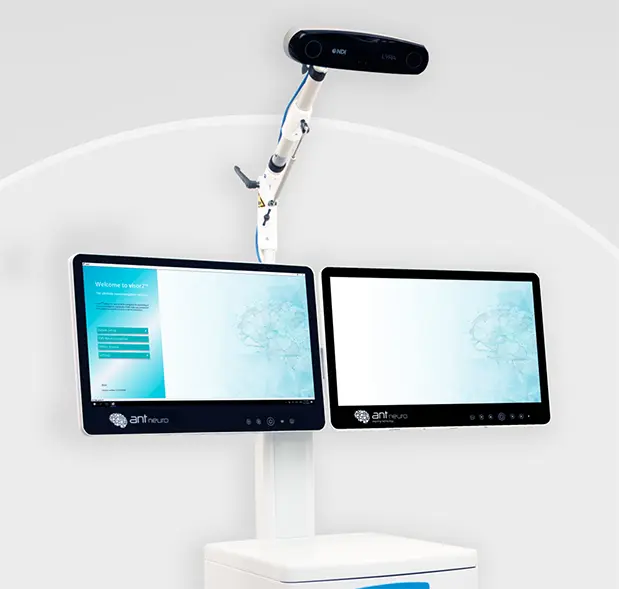
vmove is designed to integrate with visor2™ neuronavigation. visor2 provides the neuronavigation and targeting environment, while vmove adds collaborative robotic TMS coil positioning, automated targeting, and head movement compensation. Together, they provide an integrated neuronavigation and robot-assisted TMS solution, including support for MRI-guided targeting and functional mapping workflows.
vmove is designed as a robot-assisted add-on to visor2 neuronavigation, rather than as a standalone neuronavigation system. visor2 provides the neuronavigation and targeting environment, while vmove provides robotic TMS coil positioning, automated targeting, and head movement compensation.
vmove supports flat figure-of-8 TMS coils from all major TMS manufacturers. Specific coil compatibility should be confirmed for the intended TMS setup and configuration. Focused Ultrasound (FUS) device integration is also available on request, depending on the device and configuration.
vmove is designed for TMS researchers and neuroscience professionals who require precise, reproducible, and automated TMS coil positioning. It is particularly suited to research protocols involving multiple stimulation sites, repeated sessions, precise targeting, long or complex trajectories, or subject head movement. It supports TMS workflows with or without MRI guidance, depending on the configured visor2 setup and available imaging data.