BrainWaveBank Ltd. is partnering with Ulster Rugby to add cognitive monitoring to the club’s existing athlete performance and wellbeing tracking. Using the waveguard touch cap with dry EEG electrodes and an eego 8 amplifier, they can run quick sessions that fit into players’ tight schedules—testing 10–15 players per week, 2–4 times weekly, with up to six athletes assessed in parallel in ~20 minutes. The protocol combines cognitive tasks (oddball reaction/decision-making and Flanker inhibition/error awareness) with event-related EEG and resting-state (eyes open/closed) recordings, alongside lifestyle and training data (GPS load, sleep tracker, questionnaires on mood, caffeine, sleep quality). Although analysis is still underway, early results suggest clear links between sleep, training, perceived wellbeing, and both behavioral and EEG-based measures, with the goal of building models to optimize “cognitive preparedness” for match play.
Meet the Researcher

Dr. Brian Murphy from Belfast-based start-up BrainWaveBank Ltd. is currently working on a neuro-monitoring project together with Ulster Rugby, a professional rugby club based in Belfast. Ulster Rugby, under the direction of Head of Athletic Performance, Jonathan Davis, highly values their players’ performance and wellbeing. Their sport science team lead by David Drake already have well-developed models to monitor players’ athletic performance and physical wellbeing. They would now like to deepen their understanding of their players’ cognitive performance and have joined forces with BrainWaveBank.
Between training sessions and matches, the professional rugby players only have very limited time available for the EEG monitoring sessions. In order to minimize setup and application time whilst ensuring high quality EEG recordings, the waveguard touch and eego 8 amplifier were chosen for this study.
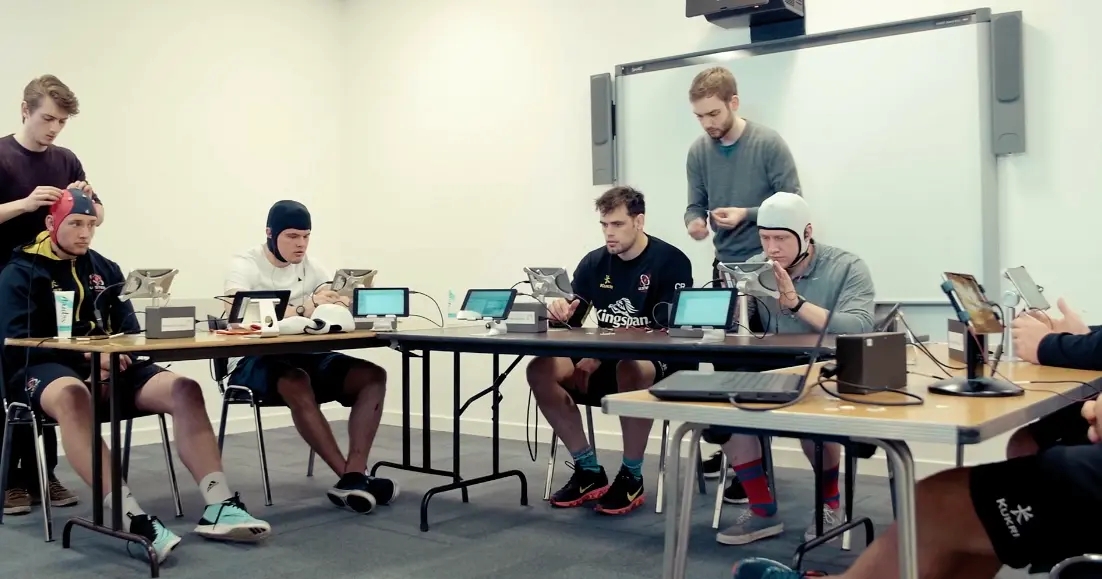
Figure 1: The rugby players performing tests whilst wearing the waveguard touch.
Set-up of study
Participants in this study are professional rugby players from Ulster Rugby. Based on availability of individual players, a total of 10-15 players are monitored each week. The EEG recordings are repeated between 2 - 4 times a week.
A two-stimulus oddball test (Linden, 2005) is used to measure speed and accuracy of reactions and decision-making of individual players. A Flanker test is administered to assess inhibition and error awareness (Eriksen & Eriksen, 1974). Behavioral measures are combined with event-related EEG metrics to provide a broad picture of cognitive health (Hillman, Kamijo & Pontifex, 2012). Eyes-open and an eyes-closed resting state EEG are recorded as a psychological measure of mental alertness (Stampi, Stone & Michimori, 1995).
Systematic qualitative and quantitative information regarding training, playing and lifestyle are collected using a variety of devices including GPS technology via Statsports, a wrist activity tracker used to measure sleep and self report questionnaire (containing questions regarding caffeine intake, mood, sleep quality etc.).
Six eego 8 systems are in use for this study. Six participants can be tested at the same time and the full sessions recordings are collected within 20 minutes.
Analysis
Data collection has just concluded. Though analysis is ongoing, we already see some clear effects of sleep, and training, and perceived well-being on behavioral and EEG based measures of cognitive performance. Ultimately, BrainWaveBank aims to develop models for measuring and actively optimizing cognitive preparedness for competitive matches.
References

Effects of noise letters upon the identification of a target letter in a nonsearch task. Perception & Psychophysics 16(1) 143-149.
by Eriksen, B.A., Eriksen, C.W. (1974).
Read More
The Relation of ERP Indicies of Exercise to Brain Health and Cognition. In C. H. Hillman, L. Scheef, & H. K. Struder (Eds.), Functional Neuroimaging in Exercise and Sport Sciences (pp. 419–446). New York, NY.
by Hillman, C. H., Kamijo, K., & Pontifex, M. B. (2012).
Read More
The P300: Where in the Brain Is It Produced and What Does It Tell Us? The Neuroscientist, 11(6), 563–576.
by Linden, D. E. J. (2005).
Read More
A new quantitative method for assessing sleepiness: The alpha attenuation test. Work & Stress, 9(2–3), 368–376.
by Stampi, C., Stone, P., & Michimori, A. (1995).
Read More