Whether you're an early-career researcher stepping into EEG, a neuroscientist planning your next experiment, or a clinician looking to bring brain monitoring into your practice, choosing the right EEG system is a critical first step. With so many options available, it can be difficult to know where to start. In this article, we’ll help you navigate the decision and find the EEG technology that best aligns with your goals.
What is an EEG system?
You probably already know what an EEG system is, but here's a simple recap: it's a setup consisting of electrodes, amplifier and a recording software, which is able to capture the brain's electrical activity. This allows you to watch the brain in action and transform neuron's signals into data you can explore.
If you're just entering the world of neuroscience - as a student, early-career researcher, or clinician - you probably already know that EEG is one of the most versatile tools to study the brain. But here comes your first challenge: choosing the right EEG system for your research.

Why choosing the right EEG system for research matters
Unfortunately, there is no universal "best" system. The right choice depends on the kind of questions you want to answer. Do you want to map brain activity with millimeter precision? Do you want to measure neural signals while someone walks, runs, or plays in virtual reality? Or do you need robust clinical recordings in a hospital environment?
At first glance, EEG systems might look similar: caps, electrodes, amplifiers, and software. But the details make all the difference. A system designed for high-density brain mapping in a quiet lab won't be the same as one built for capturing neural activity while someone sprints down a track.
Traditionally, researchers faced tough trade-offs: high-density EEG meant sacrificing mobility, while mobile setups often meant fewer electrodes and lower data quality. But technology has moved on. Modern systems allow you to combine high-quality recordings with flexibility and comfort, even outside the lab.
So instead of asking which system is the best, the real question is: what you want to study and how?
Breaking it down: key questions to guide your choice
What is your research or clinical focus?
EEG is used across an incredible range of fields: cognitive neuroscience, clinical diagnostics, movement science, sports performance, and even brain–computer interfaces. Each focus requires slightly different tools. If you are mapping cognitive processes in the lab, working with patients in a clinical setting, or exploring how the brain behaves in motion, there’s a setup that fits your specific focus. The variety of research demands is wide, and EEG system specialists developed equipment to accommodate these different needs.
Do you need mobility?
Imagine two scenarios. In the first, you're studying memory in a quiet lab, with participants sitting still in front of a screen. In the second, you're investigating how the brain controls movement in athletes during real training. Clearly, the EEG system that works perfectly for the first scenario won't necessarily fit the second.
Mobility often comes down to the number of electrodes. High-density systems with 64, 128, or even 256 channels deliver incredible spatial resolution, ideal for fine-grained brain mapping. The challenge, though, is that more electrodes usually mean more hardware, heavier setups, and longer preparation times.
Fortunately, recent advances in EEG technology have made it possible to maintain high-density recordings while keeping systems compact and portable. Companies specializing in EEG solutions, like ANT Neuro, have embraced these innovations, designing products that allow researchers to combine mobility with high-quality, high-resolution data.
Researchers no longer need to compromise between precision and freedom of movement. You can pursue real-world neuroscience questions without leaving behind the level of detail that traditional lab-based systems provide.
Who are your participants?
Children, patients, athletes - each group comes with unique challenges. Working with children requires caps that are comfortable and quick to set up. With patients, robustness and clinical reliability are key. With athletes, the system must be lightweight and non-intrusive. The flexibility of EEG caps and amplifier configurations allows you to tailor your setup to your participant group. 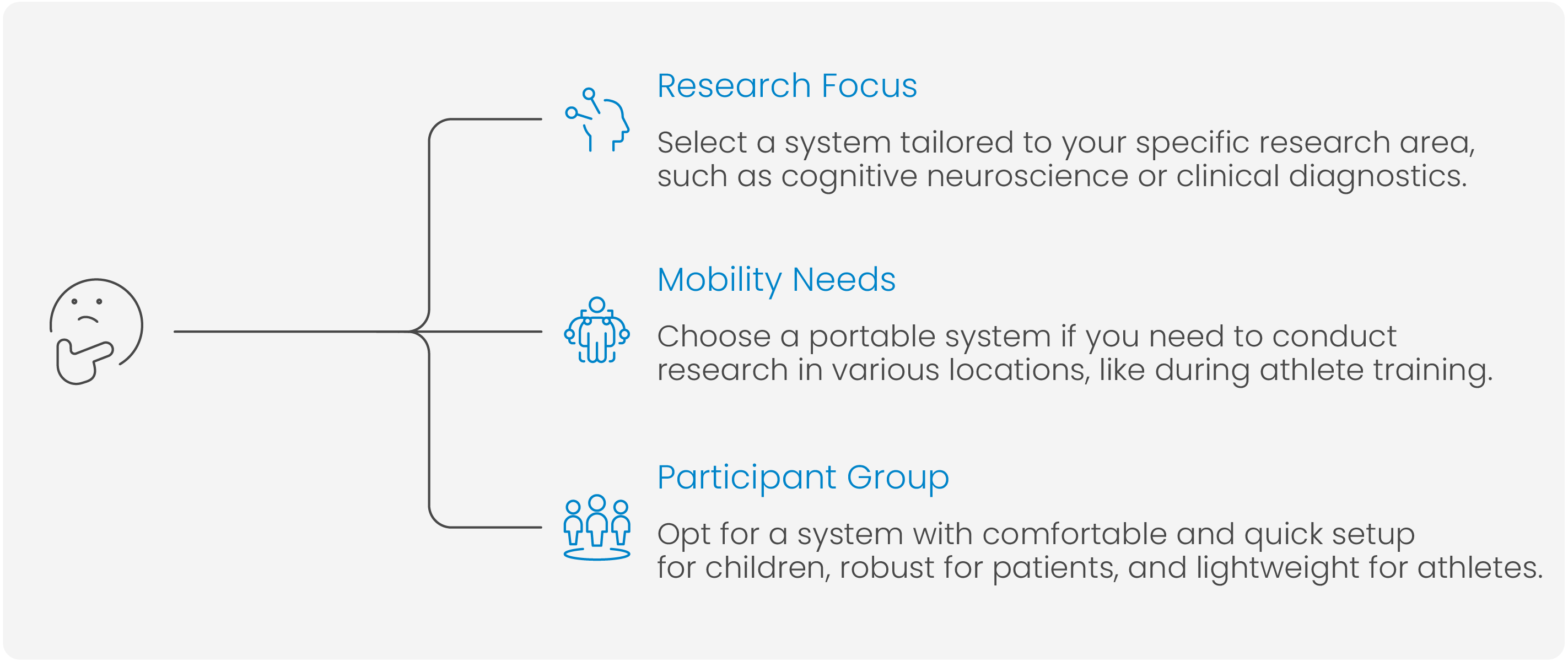
Matching EEG systems to research needs
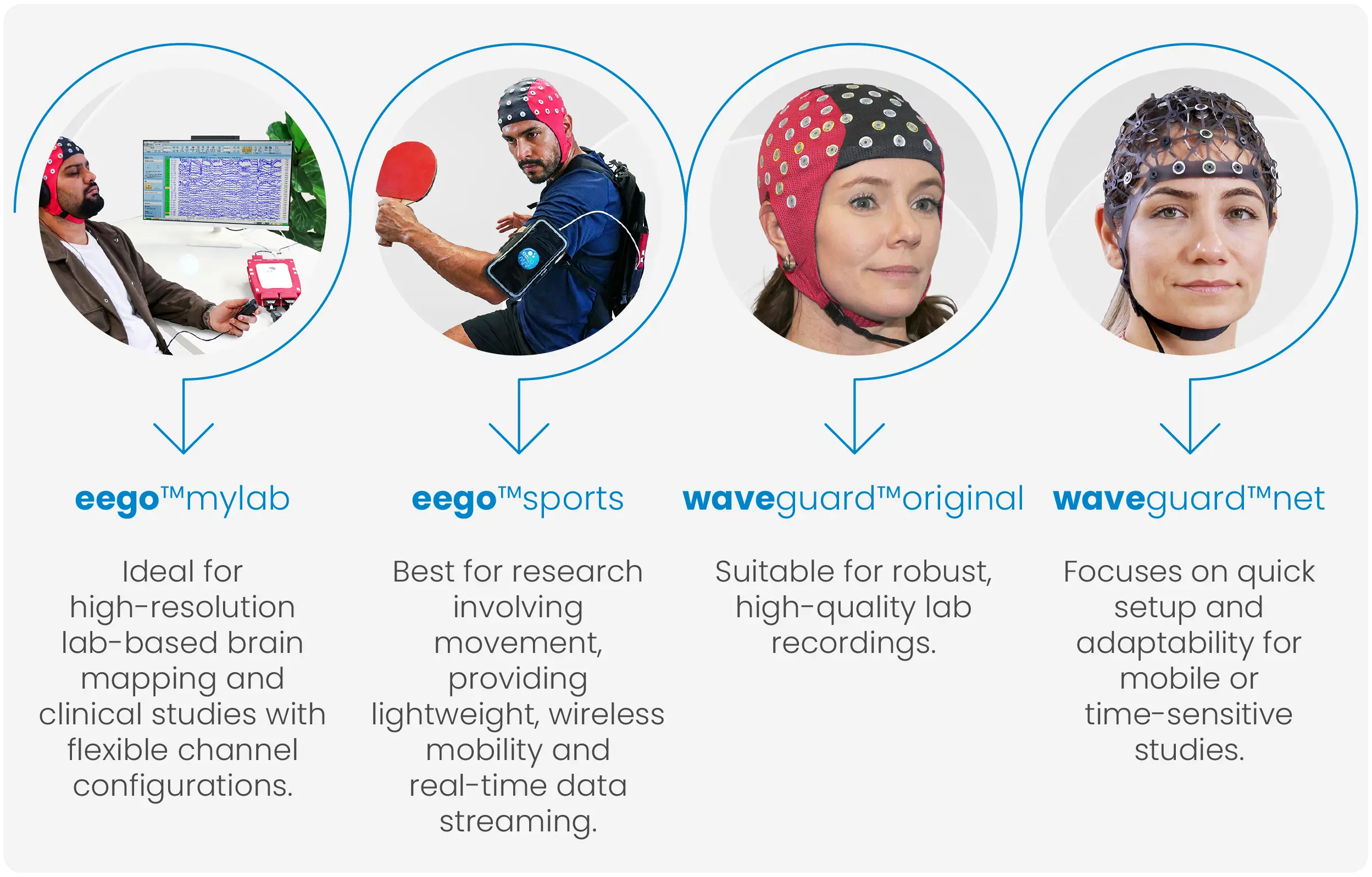
Depending on your research goals, different EEG setups may serve you best. For detailed lab-based brain mapping or clinical studies, eego™mylab allows for high-resolution recordings with flexible channel configurations. ANT Neuro has recently launched its next-generation eego amplifier — the foundation behind eego mylab, eego™sports, eego™rt, and neurofeedback solutions. Built around improved signal quality, modular scalability, and seamless multimodal integration, it brings meaningful advances to EEG for research across every setting and study design.
Powered by the next-generation eego amplifier, eego mylab supports up to 256 channels via modular cascading, 24-bit resolution, USB-C power with internal battery for uninterrupted long-duration recordings, and expanded multimodal inputs — making it one of the most capable high-definition EEG systems for research available today.
When your work involves movement - athletes training, VR experiments, or rehabilitation sessions - eego sports provides lightweight, wireless mobility without sacrificing signal quality. Built on the same next-generation eego amplifier platform, eego sports delivers up to 4 hours of wireless recording, real-time data streaming via the eego remote Android app, and multimodal capture of EEG alongside ExG, respiration, and other physiological signals — purpose-built for EEG research beyond the lab.
Choosing caps is equally important: waveguard™original offers robust, high-quality lab recordings, while waveguard™net focuses on quick setup and adaptability, ideal for mobile or time-sensitive studies.
Grow with your EEG system
As you can see, choosing your EEG system isn't just about amplifiers and caps - it's about the questions you want to answer. Your focus may shift over time, from lab-based cognitive studies to movement or clinical research, and your setup should evolve with you. Modern modular EEG systems, like ANT Neuro's eego system, let you expand and reconfigure your equipment with minimal effort.
Partnering with a reliable provider also means access to expert guidance, maintenance, and hands-on learning opportunities. When you want to gain hands-on experience with EEG applications, ANT Neuro Bootcamps give you the chance to practice in an interactive setting. If you're looking for inspiration and want to connect with fellow researchers and clinicians, ANT Neuromeetings are the place to exchange ideas and learn from each other's projects. And for everyday growth, you can turn to ANT Academy - an educational platform packed with tutorials, webinars, and practical tips. It’s the perfect companion whether you are just starting your EEG journey or aiming to take your expertise to the next level.
The right system doesn't just support your experiments - it supports your growth as a researcher.
Frequently asked questions about EEG for research
There is no single best EEG system for research — the right choice depends on your study design, participant group, and whether you need lab-based precision or mobile flexibility. ANT Neuro offers a range of research-grade systems including eego mylab for high-density lab and clinical studies, and eego sports for movement and real-world research.
Channel count depends on your research goals. 32–64 channels suit most ERP and cognitive neuroscience paradigms. 128 or 256 channels are recommended for source localization and high-density brain mapping. Mobile EEG research can be conducted effectively with 8–64 channels.
Yes. Modern wireless EEG systems like eego sports are designed specifically for real-world and mobile research — including sports science, rehabilitation, and naturalistic cognitive studies — without compromising data quality.
A multimodal EEG setup combines EEG with other physiological signals such as ExG, respiration, GSR, or imaging modalities like fMRI and MEG. ANT Neuro’s eego systems support multimodal research out of the box.
The next-generation eego amplifier is ANT Neuro’s latest amplifier platform powering eego mylab, eego sports, eego rt, and neurofeedback solutions. Key advances include improved signal quality, modular scalability up to 256 channels, 24-bit resolution, and enhanced multimodal integration.